
Sarasota Relocation Guide: Everything Before the Move
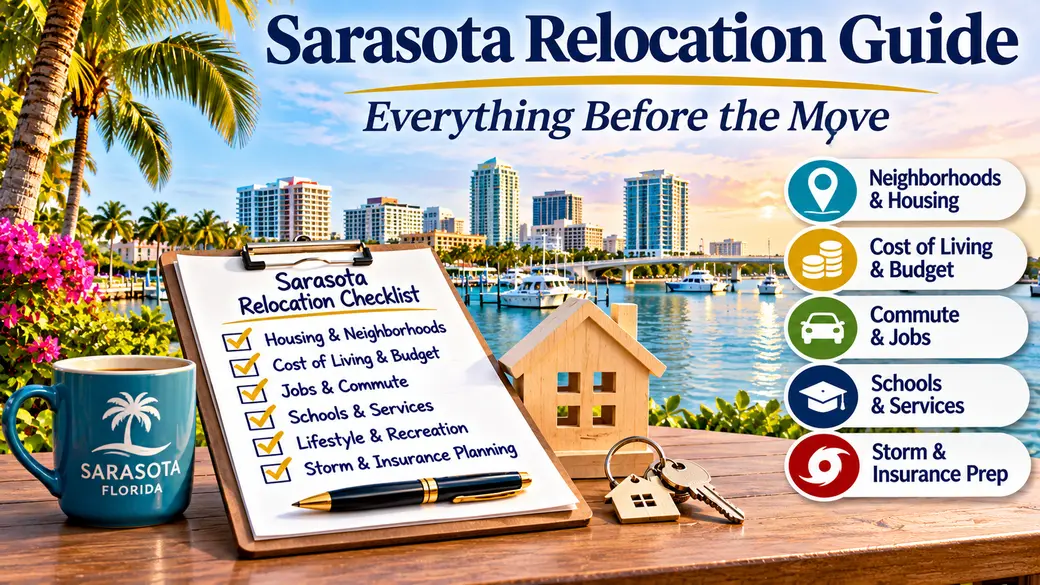
Relocating to Sarasota means planning for a coastal lifestyle, warm weather, and housing costs that can vary sharply by address. This Sarasota Relocation Guide focuses on the decisions that matter before moving: monthly ownership costs, commute patterns, schools, climate, neighborhood fit, and storm preparation. Sarasota County had an estimated 479,958 residents in July 2025, up 10.6% from the April 2020 Census base, making careful location research especially useful as the county continues to grow (U.S. Census Bureau QuickFacts).
Sarasota Relocation Quick Reference
Sarasota is a practical fit for relocators who want year-round outdoor access and a range of housing settings, while accepting that insurance, traffic, and recurring ownership costs need address-level review.
-
Housing benchmark: Sarasota County’s median owner-occupied home value was $411,800 in the Census Bureau’s 2020–2024 estimates. It is a broad ownership measure rather than a current sale-price figure, and prices differ substantially between inland neighborhoods, downtown condominiums, and coastal properties. Source: U.S. Census Bureau QuickFacts, 2020–2024.
-
Household income: Median household income was $83,416 in 2024 dollars for the 2020–2024 estimate period. This offers useful local context, but a relocation budget should be based on household income, savings, financing terms, taxes, insurance, and association costs. Source: U.S. Census Bureau QuickFacts, 2020–2024.
-
Population: Sarasota County had an estimated population of 479,958 on July 1, 2025. Population growth can affect traffic, demand for services, and competition for homes in well-located areas. Source: U.S. Census Bureau QuickFacts, July 2025.
-
Commute time: Workers in Sarasota County had a mean travel time to work of 24.5 minutes in the 2020–2024 Census estimates. Interstate 75 access, school schedules, bridge crossings, and seasonal visitor traffic can make an individual commute very different. Source: U.S. Census Bureau QuickFacts, 2020–2024.
-
Monthly ownership costs: Median selected monthly owner costs for mortgaged homes were $1,976 in the 2020–2024 estimate period. This countywide figure does not replace a property-specific budget for insurance, taxes, utilities, maintenance, and community fees. Source: U.S. Census Bureau QuickFacts, 2020–2024.
-
Biggest relocation draw: Sarasota’s strongest draw is lifestyle. Beaches, Sarasota Bay, parks, trails, arts venues, healthcare services, and outdoor recreation create a daily routine that appeals to households seeking more time outside.
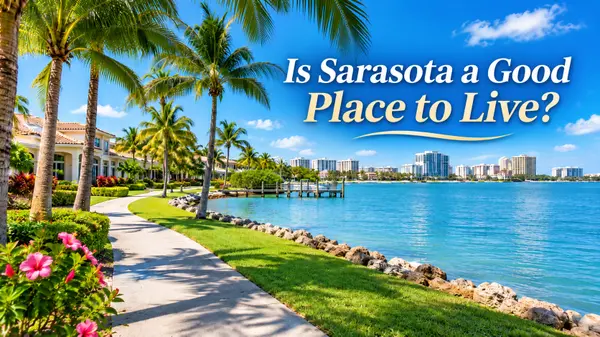
If you are considering a move to Sarasota, Florida, check out this video about moving to Sarasota, Florida for a quick breakdown of local neighborhoods, cost considerations, and what to expect when living on the Gulf Coast.
Sarasota by the Numbers
Sarasota County’s available public indicators point to a growing coastal market where housing decisions should account for both purchase price and recurring costs.
-
Median owner-occupied home value: $411,800, based on the 2020–2024 Census estimate period. Source: U.S. Census Bureau QuickFacts.
-
Median household income: $83,416 in 2024 dollars, based on 2020–2024 estimates. Source: U.S. Census Bureau QuickFacts.
-
Population: 479,958 estimated residents as of July 1, 2025. Source: U.S. Census Bureau QuickFacts.
-
Population growth: 10.6% growth from the April 2020 Census base to July 2025. Source: U.S. Census Bureau QuickFacts.
-
Mean commute time: 24.5 minutes for workers age 16 and older in the 2020–2024 estimates. Source: U.S. Census Bureau QuickFacts.
Why People Are Moving to Sarasota
People are moving to Sarasota for coastal recreation, healthcare access, cultural amenities, and housing choices that range from urban condominiums to suburban single-family communities. Sarasota County’s estimated population reached 479,958 in July 2025, a 10.6% increase from the April 2020 Census base, reflecting sustained demand for the area’s lifestyle and services.
Outdoor access is a meaningful part of daily life rather than an occasional activity. Bayfront Park, Payne Park, the Legacy Trail, Myakka River State Park, Lido Beach, and Siesta Beach support walking, cycling, paddling, fishing, and beach time throughout the year. Downtown Sarasota also combines Sarasota Bay access with restaurants, galleries, performance venues, and public waterfront spaces.
The regional economy provides another pull factor. Healthcare, education, tourism, construction, professional services, aviation, and marine science all support employment across Sarasota County. Sarasota Memorial Health Care System, Sarasota County Schools, Ringling College of Art and Design, New College of Florida, Mote Marine Laboratory & Aquarium, and Sarasota Bradenton International Airport are established institutions with a local presence.
Housing offers several versions of Gulf Coast living, including central condos, older neighborhoods, master-planned communities, and homes east of Interstate 75. The tradeoff is that taxes, insurance, association obligations, flood exposure, and travel patterns can change considerably from one address to another.
Cost of Living: Sarasota vs Nearby Areas
Sarasota County can carry different recurring costs from nearby areas because coastal exposure, association structures, home age, and proximity to employment hubs affect a household’s total monthly budget.
| Area | Housing context | Cost-of-living considerations | Household-income context | Property-tax considerations |
|---|---|---|---|---|
| Sarasota County | Downtown condos, established neighborhoods, suburban homes, and coastal properties | Insurance and association costs can vary widely by address | Median household income was $83,416 in 2024 dollars for 2020–2024 | Taxable value, exemptions, and local millage determine the bill |
| Manatee County | Newer planned communities and established housing create several price tiers | Community development district and association costs may apply in some neighborhoods | Income and commuting patterns vary by community | Parcel value, exemptions, and local taxing authorities affect taxes |
| Charlotte County | Coastal, retirement-oriented, and inland housing options create varied ownership profiles | Maintenance, insurance, and distance from services can shape expenses | Employment and retirement income patterns differ by household | Assessed value and exemptions affect individual tax bills |
| United States | Housing prices and property types differ substantially by region | National comparisons do not capture Florida insurance exposure | Income levels vary by metropolitan area | Property-tax systems vary by state and local jurisdiction |
Sarasota County income and home-value figures: U.S. Census Bureau QuickFacts, 2020–2024 estimates.
Housing Market Overview
Sarasota offers buyers a broad mix of property types, but the best fit depends on location, monthly carrying costs, and the condition of the individual home. Single-family homes range from older central Sarasota residences to newer suburban properties east of Interstate 75. Condominiums are common downtown, near the bayfront, and along barrier-island areas, while townhomes are more prevalent in newer suburban settings.
A practical search starts with the daily routine a household wants. Buyers who prioritize walkability may focus on central neighborhoods and condominium buildings. Those seeking more interior space, garages, or newer construction may find more options in suburban communities. Coastal homes can offer beach or bay access, but they also require closer attention to elevation, insurance, roof condition, association rules, and evacuation planning.
New construction remains part of the county’s housing landscape, particularly in growth corridors and planned communities. Newer homes may offer contemporary layouts and more recent building standards, though HOA, master-association, community development district, amenity, and maintenance costs should be included in the monthly comparison.
For relocators, sorting homes by property type is useful, but a complete comparison should also consider commute timing, outdoor access, recurring costs, and how the property performs during heavy rain, extreme heat, and storm season.
Neighborhoods and Communities in Sarasota
Sarasota neighborhoods provide distinct lifestyles, so the best community depends on whether a household values walkability, beach access, residential space, proximity to employers, or lower-maintenance living.
Downtown Sarasota suits people who want restaurants, arts venues, bayfront access, and a more urban daily routine. Housing includes condominium buildings, townhomes, and established residences near central services. It can work well for professionals, downsizers, and remote workers who value proximity to cultural destinations and healthcare.
Palmer Ranch offers planned neighborhoods south of central Sarasota with single-family homes, villas, and condominiums. Shopping, parks, and access to the Legacy Trail make it a practical choice for households seeking a suburban setting while remaining connected to Sarasota amenities. Families, retirees, and buyers looking for more residential space often compare this area.
Siesta Key is defined by barrier-island living, beach access, and a mix of condominiums, cottages, and waterfront homes. It can suit buyers who place Gulf access at the center of their lifestyle. Buyers should evaluate elevation, flood-zone information, insurance quotes, rental rules, bridge travel, and evacuation planning for each property rather than treating the island as one uniform market.
Gulf Gate and Southside Village can appeal to buyers looking for established streets, shopping and dining access, and a central location. Housing styles and home conditions vary block by block, making on-site comparison useful for relocators balancing budget, commute, and renovation preferences.
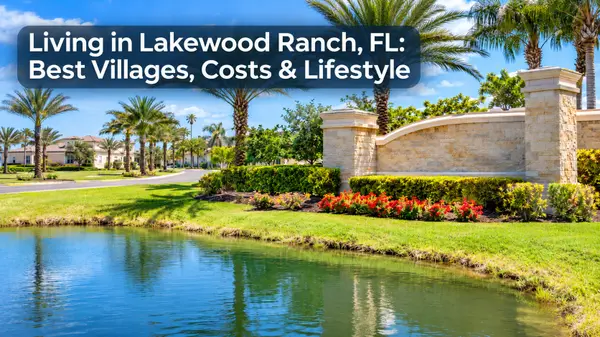
Lakewood Ranch, which spans Manatee and Sarasota counties, is often considered by households seeking newer construction, planned amenities, and neighborhood-based recreation. Community fees, district-related costs, and commute patterns should be compared alongside the home itself.
Jobs and Economy
Sarasota’s economy is anchored by healthcare, education, tourism, construction, professional services, aviation, and marine science. Sarasota Memorial Health Care System is a major regional healthcare institution. Sarasota County Schools, Ringling College of Art and Design, New College of Florida, Mote Marine Laboratory & Aquarium, and Sarasota Bradenton International Airport also support public-sector, education, research, transportation, and visitor-economy employment.
The broader North Port-Bradenton-Sarasota metropolitan area recorded a preliminary unemployment rate of 4.7% in September 2026, compared with Florida’s 4.2% rate that month, according to the U.S. Bureau of Labor Statistics. This figure covers a wider labor market than Sarasota County alone, but it is useful for understanding regional job access.
Sarasota County’s median household income was $83,416 in 2024 dollars for the 2020–2024 Census estimate period. Remote workers should verify broadband availability, mobile coverage, workspace needs, and actual travel times at the specific address they are considering.
Schools and Education
Sarasota County Schools serves families through district-operated elementary, middle, and high schools, along with charter, virtual, alternative, technical, and specialized programs. As reported in the district profile accessed in November 2026, Sarasota County Schools serves more than 44,000 students across 59 schools.
The Florida Department of Education awarded the district an A grade for the 2025–2026 school year, and Sarasota County Schools reported that all district-managed schools earned an A or B in the latest school grades. Pine View School in Osprey serves eligible gifted students, while career and technical education, charter schools, and virtual learning provide additional options.
Higher-education institutions include Ringling College of Art and Design, New College of Florida, and the State College of Florida. School attendance boundaries, program eligibility, transportation, enrollment procedures, and capacity can change, so families should confirm details directly with Sarasota County Schools for any address under consideration.
Climate and Lifestyle
Sarasota has mild winters, hot humid summers, and an outdoor lifestyle that extends through much of the year. Sarasota-Bradenton climate normals show an average January temperature of 62.4°F, a July average of 83.1°F, an August average of 83.4°F, and annual precipitation of 49.05 inches, based on 1991–2020 climate normals.
Daily recreation often revolves around water, trails, parks, and cultural events. Bayfront Park, Payne Park, the Legacy Trail, Myakka River State Park, Lido Beach, Siesta Beach, and the Sarasota Bay waterfront offer options for walking, cycling, paddling, fishing, and beach time. During summer, early mornings and evenings are generally more comfortable for outdoor exercise than midday.
Hurricane season officially runs from June through November, according to the National Hurricane Center. Before choosing a property, relocators should separately review the FEMA flood zone, Sarasota County evacuation level, insurance quote, roof age, and available wind-mitigation documentation. For barrier-island homes, including properties on Siesta Key, testing bridge travel during weekday peaks and busy visitor periods can provide a more realistic commute picture.
What to Budget Beyond the Purchase Price
-
Monthly ownership costs: Sarasota County’s median selected monthly owner costs for mortgaged homes were $1,976 in the 2020–2024 Census estimates. A specific home’s taxes, insurance, financing, and fees can produce a very different total.
-
Property taxes: Florida property taxes depend on taxable value, exemptions, and millage rates established by local taxing authorities. A prior owner’s bill may not match the bill after a sale.
-
Homeowners insurance: Premiums vary by roof age, construction, wind-mitigation features, location, coverage choices, and claims history. Coastal and flood-prone addresses can require additional budget room.
-
Association fees: Condominiums and planned communities may include HOA, master-association, club, or special-district charges. Buyers should identify what each charge covers and whether assessments may apply.
-
Utilities and maintenance: Based on 1991–2020 climate normals, Sarasota receives about 49.05 inches of annual precipitation. Air conditioning, drainage, landscaping, pool care, and exterior maintenance can be meaningful recurring expenses.
If you're relocating to Sarasota and planning to purchase your first home, understanding the upfront expenses is just as important as estimating your monthly payment. Down payments, closing costs, inspections, insurance, and moving expenses can all affect your initial budget. For a closer look at these considerations, explore our guide to planning the full cost of your first home purchase in Sarasota to prepare financially before making your move.
Sarasota Relocation Decision Framework
Sarasota, Venice, and Siesta Key offer different combinations of access, housing style, and climate exposure, so relocators should compare them according to the routine they expect to live.
| Factor | Sarasota | Venice | Siesta Key |
|---|---|---|---|
| Housing context | Condos, townhomes, established homes, and waterfront options | Historic neighborhoods, planned communities, condos, and single-family homes | Condominiums, cottages, and waterfront homes |
| Cost considerations | Central location, insurance, and building fees can influence monthly costs | Association obligations and maintenance vary by community | Coastal insurance, flood exposure, and association structures can be significant |
| School setting | Sarasota County Schools assignment depends on address | Sarasota County Schools assignment depends on address | Sarasota County Schools assignment depends on address |
| Employment access | Close to healthcare, arts, education, and professional-service employers | South-county travel patterns affect access to employment hubs | Bridge routes affect travel to central Sarasota employment centers |
| Climate planning | Heat, wind, heavy rain, and storm preparation apply | Heat, wind, heavy rain, and storm preparation apply | Coastal wind, flood exposure, and evacuation planning require close review |
| Lifestyle fit | Urban, cultural, bayfront, and walkable | Relaxed, historic, suburban, and coastal | Beach-oriented, waterfront, and resort-style |
Frequently Asked Questions About Moving to Sarasota
Is Sarasota a good place to live?
Sarasota can be a strong choice for households that value Gulf Coast recreation, healthcare access, cultural amenities, and outdoor activities throughout the year. Sarasota County’s population was estimated at 479,958 in July 2025, showing continued demand for the area’s lifestyle and services, according to U.S. Census Bureau QuickFacts.
How affordable is housing in Sarasota compared to nearby areas?
Affordability varies most by home type, proximity to water, insurance needs, association fees, and property condition. The countywide median owner-occupied home value was $411,800 in the 2020–2024 Census estimates, but a property-level budget is more useful than a broad benchmark when comparing Sarasota with nearby communities.
What are the job prospects in Sarasota?
Healthcare, tourism, education, construction, professional services, aviation, and marine science are important employment sectors in the Sarasota area. The North Port-Bradenton-Sarasota metro recorded a preliminary 4.7% unemployment rate in September 2026, according to the U.S. Bureau of Labor Statistics.
What should I know about schools in Sarasota before moving?
Sarasota County Schools offers district-operated, charter, technical, virtual, and gifted-program pathways. The district earned an A grade for 2025–2026, but attendance boundaries, transportation, eligibility rules, and program availability should be confirmed directly for the address being considered.
What are the biggest costs to budget for when relocating to Sarasota?
Beyond the purchase price, households should plan for property taxes, homeowners insurance, association fees, utilities, and climate-related maintenance. Sarasota County’s median monthly owner costs with a mortgage were $1,976 in the 2020–2024 Census estimates, though individual property costs can differ substantially.
Nicholas Rapisardi is a real estate broker for simpliHŌM, serving Manatee and Sarasota counties along Florida's Gulf Coast. More local market breakdowns are available on the Living in Sarasota | Nicholas Rapisardi YouTube channel. @livinginsarasota-lwr
Categories
Recent Posts




GET MORE INFORMATION