

Is Venice, FL a Good Place to Buy an Investment Property?

Determining whether Is Venice, FL a Good Place to Buy an Investment Property? comes down to evaluating the 2026 market fundamentals: Gulf Coast beach access, a corrected price point below comparable Florida markets, and documented demand from retirees, snowbirds, and relocating remote workers. Whether it works for your portfolio depends on property type, rental strategy, and how honestly you underwrite the full cost stack, including insurance, HOA fees, CDD assessments, and local tax obligations.
Here is what current market data shows, what Vistera of Venice brings to the investor conversation specifically, and where the real risks sit.
Venice Market Fundamentals: What Investors Need to Know First
As of mid-2026, investment fundamentals in this area are defined by three converging conditions: corrected prices, elevated days on market, and a county single-family segment that has turned seller-favorable. Each of those conditions creates different leverage depending on what you are buying.
As of August 31, 2026, 861 active listings across Venice and North Venice carried a median list price of $379,000 and an average of $298 per square foot, with an average of 124 days on market, based on aggregated MLS listing data (active inventory as of August 31, 2026, via Stellar MLS IDX). Buyers looking at active opportunities across the area can review current listings and area trends to see how pricing varies across sub-markets.
That 124-day average is the number that matters most for investors. It reflects a market with genuine aged inventory: condos, villas, and listings priced against 2022 values that have not adjusted. Motivated sellers and days on market well above 90 create negotiating room that did not exist 18 months ago.
At the county level, the picture is tighter. The REALTOR Association of Sarasota and Manatee reported in its July 2026 market release that Sarasota County single-family closed sales reached a $493,500 median, up 5.0% year over year. Active single-family inventory fell 23.4% year over year to 2,736 homes, cutting months of supply to 3.9. Sellers collected a median 94.2% of original list price, and homes went under contract in a median 52 days.
Condos remain softer. County condo and townhome inventory fell 10.9% to 1,782 units, at 5.6 months of supply. Sellers netted a median 90.8% of original ask, with a 92-day median time to contract. Cash buyers represented 59.7% of condo closings.
For an investor, the practical read is this: the single-family segment has tipped seller-favorable at the county level. Venice-specific inventory, particularly condos and aged listings averaging 124 days, still offers meaningful negotiating room. Your leverage depends on what you are buying, not just where. For a current read on local pricing trends, review our regional pricing and inventory overview.
The Venice Rental Market - Long-Term vs. Short-Term
Venice supports both long-term and short-term rental strategies, but the performance gap between the two is significant, and the regulatory environment makes STR viability a property-by-property question rather than a market-wide one.
Long-Term Rentals
Long-term rental demand in the Venice corridor draws from a consistent tenant pool: retirees in transition before purchasing, seasonal workers, and remote workers seeking Gulf Coast living without the commute burden. Based on aggregated rental listing data for the Venice and North Venice area, typical rents in the North Venice corridor run in the $3,000 to $3,600 per month range for 3-bedroom single-family homes on annual leases. Two-bedroom product generally holds in the $2,500 to $3,000 range.
On a corrected-price acquisition, gross yields from long-term rentals can run in the mid-to-upper single digits before expenses. After property management (typically 8 to 10% of gross rent), property taxes, insurance, and HOA or CDD fees where applicable, net operating income compresses substantially. The math works best with a below-median purchase price, minimal HOA overhead, and a property that does not require near-term capital expenditure.
Short-Term Rentals
The Venice STR market exists, but modest performance is the baseline. Based on aggregated rental listing data (trailing 12 months through January 2026), across approximately 306 active STR listings in the area:
| Metric | Venice STR Median |
|---|---|
| Annual revenue | ~$23,735 |
| Monthly revenue | ~$2,417 |
| Average nightly rate | ~$181 |
| Overall occupancy | ~38% |
The market is heavily seasonal: the February-through-April peak can push occupancy above 60%, while September brings monthly revenue closer to $2,100 for a median-performing property. Top-performing properties outpace those medians considerably. The bottom quartile earns well under $1,200 per month.
Location, management quality, and pricing strategy drive that gap far more than the market itself. Underwrite on median numbers, not the outlier cases.
STR Regulations Are Non-Negotiable Due-Diligence Items
Short-term rental rules in the Venice area are split by jurisdiction, and getting this wrong before purchase is an expensive mistake.
Properties inside the City of Venice require both a city Business Tax Receipt and a Florida DBPR license. Properties in unincorporated Sarasota County fall under a separate county framework with different minimum-stay requirements. In both jurisdictions, Florida state sales tax and Sarasota County tourist development tax apply to gross STR revenue and must be built into your projections from day one.
HOA governing documents are the most commonly overlooked restriction. A significant portion of Venice-area HOAs prohibit rentals shorter than 6 or 12 months and may prohibit STRs entirely. Read the governing documents before structuring a deal around a rental strategy the HOA will not allow.
Verify the specific parcel's zoning and HOA rules before making an offer. The ZIP code alone tells you nothing.
What Vistera of Venice Offers Investors
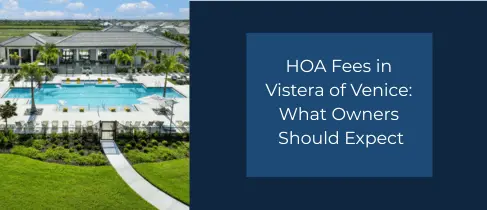
Vistera of Venice is a gated, master-planned community selling on Laurel Road in the City of Venice, just east of I-75. The development is planned for up to 582 single-family homes and villas across approximately 299 acres, with three national builders: Neal Communities, David Weekley Homes, and M/I Homes.
Neal Communities offers paired villas starting in the $300s (1,638 to 1,848 sq ft) and single-family homes starting in the $400s. David Weekley Homes and M/I Homes each start their single-family product in the mid $400s, with floor plans ranging from approximately 1,595 to 3,838 square feet across both builders. The amenity package includes a resort-style pool, clubhouse, 24-hour fitness center, walking and cycling trails, and a complimentary e-bike share program for residents.
For investors, structural details that matter include:
Maintenance-assisted model: HOA dues cover scheduled landscape maintenance, lawn care, irrigation, and mulch. That reduces the ongoing management burden for an absentee owner, but it also means dues are a fixed cost whether the unit is occupied or not.
CDD obligations: The Laurel Road Community Development District finances and maintains the community's infrastructure, including gated entry, stormwater facilities, parks, and trails. CDD assessments appear on property tax bills, are separate from HOA dues, and are mandatory. Published tax information for Vistera lists CDD fees in the $3,100 to $3,500 range per year, varying by product series. Request the current FY2026 schedule from the builder or HOA management company before finalizing figures.
Rental restrictions: As a gated HOA community with enforced deed restrictions, Vistera has rules governing how the property can be used. Confirm in writing what the governing documents allow regarding minimum lease terms and STR permissions before purchasing with a rental strategy in mind.
New construction advantage: New construction reduces near-term capital expenditure risk compared with Venice's older resale stock built primarily in the 1960s through 1990s. A modern-code home with impact-rated windows, updated roofing, and contemporary electrical typically carries lower insurance friction and more predictable near-term maintenance costs.
The Cost Stack: What Florida Really Charges You
Every Venice investment analysis has to account for four line items that frequently break pro formas.
Property taxes: Venice's effective property tax rate runs approximately 1.11% (based on 2023 data), slightly above the national median of 1.02%, with a median annual bill near $3,375. Investment (non-homesteaded) properties receive no Homestead Exemption and no Save Our Homes cap on annual assessment increases. The tax bill can reset fully to the purchase price upon acquisition.
Insurance: Venice holds a Class 5 Community Rating System rating from FEMA, as confirmed by the City of Venice's Floodplain Management office, providing a 25% discount on National Flood Insurance Program premiums for properties in Special Flood Hazard Areas. That discount does not make flood insurance inexpensive on a waterfront or Zone AE or VE property. Venice's flood maps have been updated in stages, most recently in April 2026, reclassifying some parcels into higher-risk zones. Coastal and Zone AE or VE properties can carry annual flood premiums ranging from several thousand dollars upward depending on coverage, elevation, and zone designation. Get a bindable flood and homeowners insurance quote on the specific address before going under contract.
HOA and CDD fees: In newer master-planned communities, these can run $2,000 to $4,000 or more per year combined, on top of mortgage, taxes, and insurance. For Vistera of Venice, request the current FY2026 fee schedule from the builder or HOA management company before finalizing pro forma projections.
Property management: For absentee investors on long-term rentals, management typically runs 8 to 10% of gross rent. Full-service STR management runs materially higher.
Run all four through the model before making any revenue projections.
Venice vs. Comparable Gulf Coast Markets
The REALTOR Association of Sarasota and Manatee July 2026 data puts Venice's price position in context:
| Factor | Venice (Active Inventory, Aug 2026) | Sarasota County (July 2026 Closings) |
|---|---|---|
| Median list / sale price | $379,000 | $493,500 SF / $340,000 condo |
| Average price per sq ft | $298 | ~$300 SF (active) |
| Months of supply | Tracks county by type | 3.9 SF / 5.6 condo |
| Days on market | 124 avg (active) | 52 median to contract |
| Effective property tax rate | ~1.11% (2023 data) | ~1.09% county avg |
Venice's $379,000 median list price sits below the county's $493,500 single-family closed median, partly because Venice carries proportionally more condo and 55-plus product. The Naples area, for context, saw a single-family median of $745,000 in July 2026, up 12.9% year over year, per the Naples Area Board of REALTORS. Venice delivers comparable beach access, healthcare infrastructure through Sarasota Memorial's Venice campus, and Gulf Coast living at a materially lower entry point.
That value position is the core investment argument for Venice: similar quality-of-life amenities at a lower acquisition cost, in a county whose single-family segment has already turned seller-favorable.
Who Venice Works Best For and Who Should Look Elsewhere
Venice works well for investors targeting long-term buy-and-hold with a 5-plus year horizon, those who can acquire below-median resale with minimal HOA overhead, and buyers pursuing new construction in communities like Vistera for lower near-term maintenance risk. It also works for investors who understand that positive cash flow from day one requires specific acquisition prices and rental structures, not broad market assumptions.
Venice is a harder case for:
- Investors who need immediate STR income to service debt without first verifying zoning compliance
- Those who project top-quartile STR performance as the base case
- Buyers who have not fully modeled insurance, CDD fees, and property management costs
- Anyone seeking a market with a strong young-renter demographic
According to the U.S. Census Bureau's 2020 to 2024 American Community Survey, Venice's median age is 69.2, among the highest of any city in Florida, which shapes the tenant pool significantly.
For a realistic read on what specific properties pencil out to at current prices and expenses, investors can utilize our home valuation resource alongside our calculator to test potential return scenarios. To see how these numbers fit into broader regional dynamics, review our deep dive on Venice and North Port 2026 market trends to make an informed decision before entering the local market.
Frequently Asked Questions
-
Is Venice, FL a good place to buy an investment property in 2026?
Venice presents a credible case, particularly for long-term buy-and-hold investors. Prices have corrected from their 2022 to 2023 peaks, 861 active listings are averaging 124 days on market as of August 2026, and the county's single-family median of $493,500 remains well below comparable Gulf Coast markets like Naples. Key qualifiers: short-term rental income is modest at the median (around $23,735 annually, trailing 12 months through January 2026) and heavily regulated by jurisdiction and HOA rules. The full cost stack, including insurance, property taxes at approximately 1.11% (based on 2023 data), HOA, and CDD fees, must be modeled before any revenue projection.
-
What does an investment property cost in Venice, FL?
As of August 31, 2026, the median active list price across Venice and North Venice is $379,000, at an average of $298 per square foot, based on aggregated MLS listing data. Condos and villas typically list in the $170,000 to $350,000 range. Mainland single-family starts in the mid-$300s for older stock. New construction at Vistera of Venice runs from the $300s for Neal Communities paired villas to the mid $400s and up for single-family homes from David Weekley and M/I Homes, depending on builder and floor plan.
-
Can I run a short-term rental at Vistera of Venice?
This requires verifying the HOA's governing documents for Vistera of Venice before purchase. As a gated HOA community, Vistera enforces deed restrictions that govern rental use, including minimum lease terms and STR permissions. Beyond HOA rules, STR operators in the City of Venice also need a city Business Tax Receipt and a Florida DBPR license, and state and county taxes apply to gross rental revenue. Confirm what is permitted in writing before structuring an acquisition around any specific rental strategy.
-
What are property taxes like on investment properties in Venice, FL?
Venice's effective property tax rate is approximately 1.11% (based on 2023 data), compared with a national median of 1.02%, with a median annual bill near $3,375. Investment (non-homesteaded) properties receive no Homestead Exemption and no Save Our Homes annual assessment cap, so your bill resets fully to the purchase price when you acquire the property.
-
What is the flood insurance situation for Venice, FL investors?
Venice holds a Class 5 CRS rating from FEMA, confirmed by the City of Venice's Floodplain Management office, giving SFHA property owners a 25% discount on NFIP premiums. Venice's flood maps have been updated in stages, most recently in April 2026, reclassifying some parcels into higher-risk zones. The city's coastal geography means a significant share of properties carry flood exposure across a range of zone designations. Annual flood premiums for Zone AE or VE properties can run from several thousand dollars upward depending on coverage, elevation, and structure type. Get a bindable quote on the specific address, not the neighborhood or ZIP code, before finalizing your investment analysis.
-
How does Vistera of Venice compare to other Venice communities for investors?
Vistera of Venice is a new-construction gated community with three national builders, resort-style amenities, and a maintenance-assisted HOA model that covers landscaping and irrigation. New construction carries lower near-term maintenance risk compared with Venice's older resale inventory, most of which dates from the 1960s through 1990s. The tradeoff is a combined HOA and CDD fee obligation on top of mortgage, taxes, and insurance. For investors, the rental restriction question is critical: confirm lease-term permissions in the governing documents before purchase, and request the current FY2026 fee schedule to complete your cost model.
Nicholas Rapisardi is a real estate broker for simpliHŌM, serving Manatee and Sarasota counties along Florida's Gulf Coast. More local market breakdowns are available on the Living in Sarasota | Nicholas Rapisardi YouTube channel. @livinginsarasota-lwr
Categories
Recent Posts




GET MORE INFORMATION